Alumni Sharing: Chin-Ting Yeh, 5th Graduating Class of the Bachelor's Program
From Economics to the Securities Industry: Insights into Career Planning — Alumni Lecture by Manager Chin-Ting Yeh
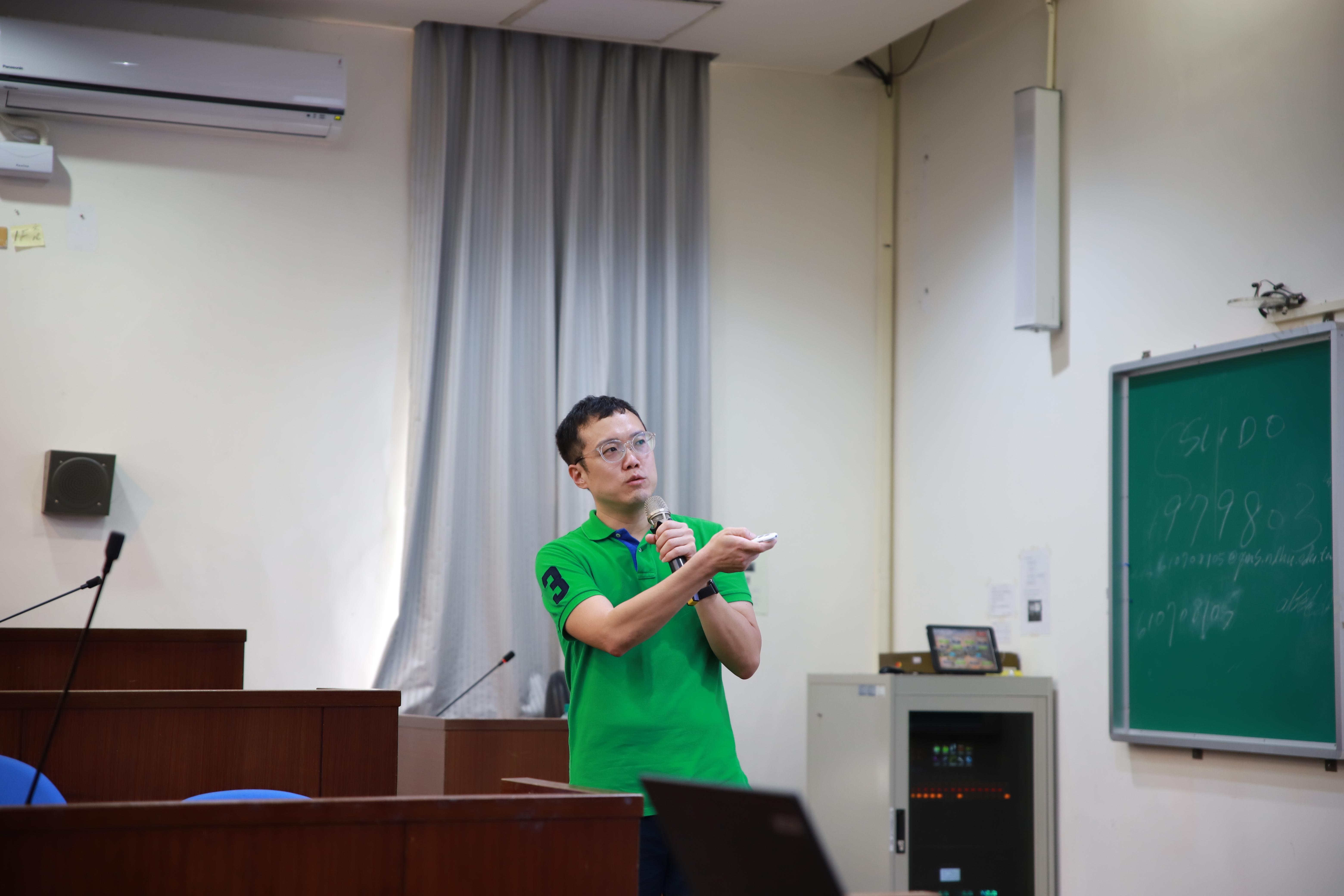
On September 20, 2024, the Department of Economics held its first lecture of the semester, inviting alumnus Chin-Ting Yeh, currently Manager of Yuanta Securities' Xinsheng Branch, to give a special lecture entitled “Moving with the Market, Looking toward a Promising Financial Future.” He shared his experience in the securities industry and introduced the evolution of the industry, job responsibilities, and employment opportunities, helping younger students at NDHU better understand the prospects and opportunities in this field.
At the beginning of the lecture, Manager Yeh shared how the professional knowledge he acquired at university has been highly useful in his work. For example, when conducting technical analysis, he frequently applies the concept of standard deviation from econometrics. Understanding what measures a central bank uses to stimulate economic growth and what effects those measures produce is also closely related to Money and Banking and Macroeconomics. He then shared another important skill he developed at university—“learning how to learn.” He emphasized that economics is highly logical. Through logical deduction, problems can be broken down layer by layer, helping students understand their fundamental nature and identify solutions. This way of thinking not only facilitates the acquisition and internalization of new knowledge but also develops problem-solving abilities.
He also explained the professional certifications required for securities industry practitioners. Financial Ethics and Common Knowledge, Securities Specialist, and Futures Specialist are essential basic certifications. Other relevant professional qualifications include Securities Investment Trust and Consulting, Senior Securities Specialist, Financial Planning Personnel, Life Insurance, Property Insurance, Investment-Linked Insurance, and the certification for life insurance agents selling non-investment-linked insurance products with premiums and benefits denominated in foreign currencies. He encouraged younger students to take the Senior Securities Specialist examination directly from the outset. Although the senior-level examination includes one additional subject compared with the entry-level Securities Specialist examination, obtaining the senior-level certification from the beginning is more efficient than spending additional time reviewing the material later, and it can also help with future promotion into managerial positions.
Finally, Manager Yeh encouraged younger students not only to obtain professional certifications and pay closer attention to major international economic and financial news during their university years, but also to consider making small-scale investments and seeking internship or part-time work opportunities. Internships and part-time jobs can help students understand basic practical operations, financial products, and marketing, while greater familiarity with the financial industry can help them identify their future career direction. At the same time, because the financial industry primarily provides highly professional services, employees inevitably face pressure related to sales performance, risk control, colleagues, and other factors. To better adapt to workplace pressures, students may consider developing personal interests, establishing regular exercise routines, and cultivating good work habits so that they can work more efficiently and effectively.
He also advised job seekers to understand factors such as corporate culture, brand image, salary and benefits, and career development and training systems in order to choose a company that suits them. He further noted that attitude, interpersonal relationships, and professional knowledge are particularly important for those entering sales positions in the financial industry. In addition to having the necessary professional expertise, employees should approach customers with a positive attitude and use flexible thinking to address challenges encountered at work.Recorded and compiled by Tzu-Chun Tsai and Yen-Chuang Chung 2024/9/21